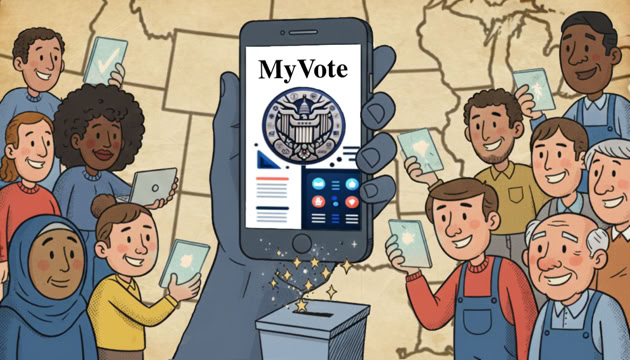
“A modern government of the people, by the people, and for the people needs information from the people to build a better future. So MyVote uses direct polling of every citizen to eliminate the guesswork and deliberate misreading of the public will by one-sided media coverage.
Instead of paying a lobbyist to buy the attention of your elected representative, your community will now be able to sign official petitions for your grievances, promote real legislation, and vote on policy changes.
You can even build your own ideal budget to share your priorities with friends and representatives.”
- MyVote Demo Video
The Problem: Nobody Knows What “The People” Actually Want
Democracy is supposed to be government by the people—but we have no reliable way to know what “the people” actually want. Politicians claim to represent you while citing polls that can't verify respondents. Media claims to report public opinion while cherry-picking data that fits their narrative. Lobbyists claim to speak for citizens while representing corporate interests. Everyone invokes “the will of the people” without any verifiable evidence of what that will actually is.
The information crisis is making democracy impossible.
Traditional Polling Is Fundamentally Broken
Every policy debate begins with competing claims about what Americans want:
“Americans oppose this policy!” says one side, citing a poll.
“Americans support this policy!” says the other side, citing a different poll.
Both polls exist. Both claim scientific methodology. Both purport to measure public opinion. Yet they show completely opposite results.
Why? Because traditional polling can't verify anything.
The Fatal Flaws
Unknown Respondents: When you see “national poll of 1,200 likely voters,” nobody knows:
• Are they actually registered voters? (Pollsters ask, but can't verify).
• Will they actually vote? (Pollsters create “likely voter models” that are often wrong).
• Do they live where they claim? (No verification possible).
• Are they who they say they are? (For online polls, could be bots, foreign operatives, or the same person answering multiple times).
Pollsters are sampling an unknown population with unknown characteristics. It's like trying to determine the average height of Americans by measuring people walking past a Big-and-Tall store and assuming they represent everyone.
Impossibly Small Samples: 1,200 people out of 160 million voters is 0.00075% of the population. The margin of error is typically ±3-4%, meaning a poll showing 52% support vs. 48% opposition is statistically indistinguishable from a tie—yet media treats it as decisive evidence of public opinion.
Different polls with the same methodology show wildly different results because tiny samples amplify random variation. Yet campaigns, media, and politicians treat these numbers as gospel truth.
Selection Bias: Who actually answers polls?
• Phone polls: Mostly elderly people with landlines (young people don't answer unknown numbers)
• Online polls: Self-selected respondents who click links (not representative of anyone)
• Response rates: Under 6% for phone polls (what do the other 94% think? Nobody knows)
The people who respond to polls are fundamentally different from people who don't—more politically engaged, more opinionated, more available. They don't represent voters. They represent “people who answer polls.”
Question Manipulation:
“Do you support raising taxes?" → 32% yes, 68% no.
“Do you support adequately funding schools and infrastructure?” → 71% yes, 29% no.
Same policy. Different framing. Opposite results. Pollsters can engineer any outcome they want through question design.
Partisan Polling Shops: Some firms consistently lean toward one party because of methodology choices, question framing, or outright bias. Campaigns commission polls from friendly pollsters, then cite them as “independent polls show…” Media cherry-picks polls that support their narrative. Everyone claims data supports them.
The Result: Politicians cite whichever poll supports their position. Media amplifies whichever narrative drives engagement. Lobbyists commission polls designed to manufacture consent. Nobody knows what citizens actually think because the measurement tools are fundamentally broken.
The “Will of the People” Becomes Whatever Powerful Interests Say It Is
In the absence of reliable polling, “public opinion” becomes a weapon wielded by whoever has the loudest megaphone.
Politicians Claim Mandates That Don't Exist:
• “The American people clearly want tax cuts!” (Based on a poll of 800 people with a ±4% margin of error.)
• “My constituents demand immigration reform!" (Based on which constituents? The ones who call your office? The ones at your carefully stage-managed town halls?)
• “This legislation reflects the will of the voters!” (Which voters? How do you know?)
Media Creates False Narratives:
• Cable news: “Americans are outraged about X!” (Based on Twitter trending topics driven by bot farms.)
• Newspapers: “Polling shows voters prioritize Y!” (Based on a single poll contradicted by three others they don't mention.)
• Social media: “Everyone thinks Z!” (Based on algorithmic amplification of divisive content.)
Lobbyists Manufacture Consent:
Corporate interests spend millions commissioning polls designed to show public support for their positions:
• Energy companies: “Poll shows Americans oppose climate regulations that raise costs!”
• Tech companies: “Poll shows Americans value innovation over privacy restrictions!”
• Healthcare industry: “Poll shows Americans oppose government-run healthcare!”
These polls use loaded questions, unrepresentative samples, and biased framing. But they generate headlines like “New poll shows Americans support industry position!” Politicians cite them. Media reports them. Public opinion becomes whatever lobbyists can afford to manufacture, and the media repeats it over and over.
Special Interests Flood Comment Periods:
When federal agencies propose regulations, they're required to accept public comments. Sounds democratic, right?
In reality:
• 90%+ of comments come from organized corporate lobbying campaigns.
• Companies pay firms to submit thousands of identical form letters.
• Real citizens have no idea comment periods exist.
• Agencies cite “overwhelming public opposition” based on manufactured comments.
Example: When the FCC proposed net neutrality rules, millions of comments were submitted. Analysis found that many came from fake names, stolen identities, and bot-generated text. Nobody knows what actual citizens thought because the process was flooded with fake input.
The New York Attorney General's investigation found that nearly 18 million of the more than 22 million comments the FCC received in its 2017 proceeding to repeal net neutrality rules were fake. The broadband industry funded a secret campaign that generated more than 8.5 million fraudulent comments using stolen identities. An additional 9.3 million fake comments supporting net neutrality used fictitious identities, most submitted by a single 19-year-old college student using automated software.
The Consequence: Democracy becomes government by whoever can most effectively manipulate the perception of public opinion. Not government by actual public opinion—government by the illusion of public opinion, crafted by those with resources to manufacture it.
Representatives Govern Blind, Then Claim Mandate
Your representative is supposed to represent you. But how do they know what you want?
Current Information Sources:
• Town halls: Attended by the most motivated (often most extreme) constituents, not representative of the district.
• Phone calls and emails: Disproportionately from organized advocacy groups mobilizing supporters.
• Polls: Unreliable, contradictory, and often commissioned by interest groups.
• Media coverage: Skewed toward the sensational and divisive.
• Lobbyist meetings: Direct access purchased through campaign donations.
The result: Representatives make decisions based on incomplete, unrepresentative, often manipulated information. Then they claim they're doing “what my constituents want” without any verifiable evidence.
When you disagree with their votes, they cite polls or town halls or constituent calls that “prove” they're representing the district. You have no way to verify or dispute these claims because there's no authoritative measurement of actual constituent opinion.
Policy Debates Happen in an Information Vacuum
Congress debates major legislation affecting millions of Americans. What do Americans actually want? Nobody knows for sure.
Healthcare Reform:
• Proponents cite polls showing “Americans want universal healthcare!”
• Opponents cite polls showing “Americans oppose government-run healthcare!”
• Both are citing real polls. Both claim to represent public opinion. Neither can be definitively verified.
Climate Policy:
• Environmentalists cite polls showing “Americans want climate action!”
• Industry cites polls showing “Americans oppose costly regulations!”
• Media runs stories about both polls, but always protects their advertisers. And politicians cite whichever supports their position. Actual public opinion remains unknown.
Immigration Reform:
• Reform advocates cite polls showing “Americans support a pathway to citizenship!”
• Restrictionists cite polls showing “Americans want border security first!”
• The debate becomes dueling polls with no authoritative source of truth.
The Human Cost: Policies get enacted or blocked based on false perceptions of public opinion. Politicians vote against what their constituents actually want because they're relying on manipulated polls, astroturf campaigns, or lobbyist pressure instead of real constituent sentiment.
Your district might overwhelmingly support a policy, but your representative votes against it because they're listening to the wrong sources. Then they claim they represented the district based on flawed data you can't dispute.
The Solution: Verified Polling That Can't Be Manipulated, Ignored, or Spun
MyVote implements authenticated, continuous polling of verified voters on every major issue, creating an authoritative, transparent, undeniable measurement of actual public opinion that politicians, media, and lobbyists cannot manipulate or ignore.
Here's how verified polling transforms democracy from guesswork into data…
Authentication: Finally Knowing Who We're Asking
Every MyVote poll respondent is…
Biometrically Verified:
• Face ID, Touch ID, or Android biometric authentication
• Liveness detection (you must be physically present, not a photo/video/deepfake)
• One person, one response per poll (no duplicate accounts)
Voter Registration Verified:
• Confirmed registered voter in the relevant jurisdiction
• Address verified to correct precinct/district
• Registration status confirmed (active, not suspended or inactive)
This solves traditional polling's fundamental problem: we finally know who we're surveying.
When MyVote says “67% of Congressional District 12 supports policy X,” that's 67% of verified registered voters in that district, not 67% of whoever happened to answer a phone call or click a link.
Massive Sample Sizes: Measuring, Not Estimating
Traditional polls survey 800-1,200 people and extrapolate to millions with margins of error of ±3-4%.
MyVote polls can include:
• Local issues: Thousands of verified voters (often 5-20% of total electorate)
• State issues: Tens of thousands of verified voters
• National issues: Hundreds of thousands or millions of verified voters
Example:
Traditional Poll: “National poll of 1,200 likely voters shows 52% support for climate legislation, 45% oppose, 3% undecided. Margin of error: ±3.5%”
Translation: We asked 1,200 people and got 624 yes, 540 no, 36 undecided. With the margin of error, this could actually be anywhere from 48.5% to 55.5% support—essentially, we don't know.
MyVote Verified Poll: “MyVote poll of 847,392 verified voters shows 58.3% support for climate legislation, 34.2% oppose, 7.5% undecided. Margin of error: ±0.1%”
Translation: We asked 847,392 verified registered voters and got 493,837 yes, 289,848 no, 63,707 undecided. This is so accurate that the margin of error is negligible. We're not estimating public opinion. We're measuring it.
Transparent Methodology: Everyone Sees the Same Data
Every MyVote poll shows…
Complete Methodology:
• Sample size (number of verified voters who responded)
• Sampling method (random sample, full population invitation, etc.)
• Response rate (what percentage of invited voters participated)
• Demographic weighting (if applied, and why)
• Confidence interval (statistical certainty level)
• Date conducted
• Exact question wording
Raw Data Available:
• Aggregate results downloadable by anyone
• Demographic breakdowns visible
• Geographic breakdowns by precinct/district/region
• Trend data showing how opinion changes over time
No Proprietary Black Boxes: Unlike traditional polls where methodology is often hidden or vague, MyVote polling is completely transparent. Any statistician, political scientist, or journalist can verify the data independently.
Impossible to Cherry-Pick or Spin
Right now, politicians and media cite whichever poll supports their narrative and ignore the rest:
• “Poll A shows Americans support my position!” (Ignore polls B, C, and D showing the opposite.)
• “Recent polling indicates momentum for our side!” (Cherry-pick the one outlier poll.)
With MyVote as the authoritative source…
There's one definitive measurement of public opinion on any given issue. Not five contradictory polls. One verified, transparent, undeniable data source.
A politician can't cite a friendly pollster when MyVote verified polling shows the opposite. Media can't create false narratives when everyone can see the same verified data. Lobbyists can't commission misleading polls when MyVote's massive, verified sample makes their tiny, biased polls obviously irrelevant.
Continuous Tracking: Not Snapshots, But Movies
Traditional polls are snapshots—they tell you what a tiny group thought on a specific day. MyVote polls are continuous tracking.
How Issues Evolve:
• January 2025: MyVote poll shows 45% support for climate legislation, 38% oppose, 17% undecided.
• April 2025: After major climate events and policy debate, 52% support, 35% oppose, 13% undecided.
• July 2025: After industry campaign against legislation, 48% support, 39% oppose, 13% undecided.
• October 2025: After revised legislation addressing concerns, 58% support, 34% oppose, 8% undecided.
This shows:
• How public opinion responds to events.
• How persuasion campaigns impact views.
• How policy changes affect support.
• How opinion crystallizes as people learn more.
Politicians can see which direction opinion is moving and why. Media can report on actual trends, not speculate. Citizens can see how their community's views evolve with information.
Representatives Get Real-Time Constituent Data
Your representative no longer has to guess what you want based on town hall attendance, phone calls from activists, or lobbyist claims. They have verifiable data showing what their actual constituents think.
Example: Congressional District 12 Considers Climate Legislation
MyVote Verified Poll of District 12 Voters:
• Sample: 52,847 verified registered voters in District 12 (10.2% of 520,000 total)
• Margin of error: ±0.4%
Results:
• Support climate legislation: 61.3%
• Oppose climate legislation: 31.2%
• Undecided: 7.5%
Demographic Breakdown:
• Age 18-35: Support 72%, Oppose 21%
• Age 36-55: Support 63%, Oppose 29%
• Age 56+: Support 51%, Oppose 39%
• Urban voters: Support 71%, Oppose 22%
• Suburban voters: Support 62%, Oppose 30%
• Rural voters: Support 43%, Oppose 48%
This Is Undeniable Information
Rep. Johnson can't claim “my district opposes this legislation” when verified polling shows 61.3% support. She can still vote no—representatives aren't required to follow majority opinion—but she must be honest about what her constituents actually want.
She might explain: “While 61% of my constituents support this in polling, I believe the economic impacts warrant a no vote because…” That's legitimate representative judgment. But she can't lie about what constituents want.
Lobbyists Lose Their Power to Claim Representation
An energy industry lobbyist can't walk into Rep. Johnson's office and claim “my polling shows your constituents oppose this legislation” when MyVote verified polling shows 61.3% support. The lobbyist's poll is obviously garbage when compared to verified data from 52,847 actual constituents.
Lobbying doesn't disappear—lobbyists can still make arguments about policy impacts, economic effects, and implementation challenges. But they can't manufacture fake constituent opposition when real constituent support is verifiable.
Media Must Report Facts, Not Narratives
Cable news loves conflict, so they amplify the most extreme voices and create false impressions of public opinion:
• “Americans are divided on climate policy!” (As they show a shouting match between activists.)
• “Debate rages over proposed legislation!” (As they show paid protesters on both sides.)
With MyVote verified polling…
“MyVote polling shows 61% of District 12 voters support climate legislation, 31% oppose. Rep. Johnson voted no despite clear majority support in her district.”
Media can still analyze and debate—but they must start with the facts. They can't create false narratives about divided opinion when verified polling shows clear majority support or opposition.
Journalists can do real accountability reporting:
• “Rep. Johnson voted no on climate bill despite 61% constituent support. Her explanation: [quote]. Do voters find this persuasive?”
• “Districts that voted yes despite constituent opposition: [list]. Districts that voted no despite constituent support: [list].”
• “How representatives vote compared to constituent polling: Analysis shows [data].”
This is real journalism: holding representatives accountable using verifiable data, not speculation about what constituents might want.
Policy Debates Start with Facts, Not Competing Polls
When Congress debates legislation, the conversation changes fundamentally.
Traditional Debate:
• Senator A: "Americans want this policy!” (cites poll from a friendly pollster).
• Senator B: “Americans oppose this policy!” (cites a different poll).
• Media: “Americans are divided on controversial legislation!”
Debate with MyVote Verified Polling:
• Senator A: “MyVote verified polling shows 58% national support, 34% opposition, 8% undecided.”
• Senator B: “Yes, but in my state, verified polling shows 42% support, 51% opposition.”
• Media: “National polling shows support, but several states show opposition. Here's the breakdown by state with verified data.”
The debate shifts from “what do people want?” (unknowable without verified polling) to “given that we know what people want, what's the right policy?” (legitimate policy debate).
Senators can still disagree about whether to follow public opinion—that's the essence of representative vs. direct democracy. But they can't disagree about what public opinion actually is.
Special Interests Can't Flood the Zone with Fake Consensus
Right now, corporations commission polls showing “Americans support” whatever position benefits their bottom line. These polls use loaded questions, tiny samples, and biased methodology—but they generate headlines from friendly news sources.
With MyVote as the authoritative source…
Corporate-commissioned polls become obviously suspect when they contradict verified polling:
Industry Poll: “New poll shows 71% of Americans oppose regulations on industry X!” (commissioned by industry X, with 800 respondents, to the question: “Do you oppose costly regulations that could eliminate jobs?”)
MyVote Verified Poll: 847,392 verified voters, 61% support regulating industry X, 32% oppose, 7% undecided. Question: “Do you support federal regulation of industry X to address [specific problem]?”
Media can report: “Industry claims majority opposition, but MyVote verified polling of 847,000 voters shows 61% support. Industry poll surveyed 800 people with a loaded question.”
The industry poll becomes obviously irrelevant when compared to verified data from almost a million actual voters.
Participatory Budgeting: You Build the Budget
The federal budget is $6.75 trillion of incomprehensible complexity. MyVote makes it understandable and lets you build your own version to show representatives your priorities.
The MyVote Budget Builder
You log into MyVote and access the Budget Builder tool. You're presented with the current federal budget broken down into major categories:
Mandatory Spending ($4.1 trillion - Social Security, Medicare, Medicaid, etc.):
You see each program with clear explanations:
• Social Security: $1.4T - Retirement and disability benefits for 67 million Americans.
• Medicare: $1.0T - Healthcare for 65 million Americans over 65.
• Medicaid: $600B - Healthcare for 85 million low-income Americans.
• Other mandatory: $1.1T - Veterans benefits, federal pensions, nutrition assistance, etc.
Discretionary Spending ($1.7 trillion - Everything else Congress votes on):
• Defense: $850B - Military personnel, weapons systems, operations.
• Education: $80B - K-12 support, college aid, research.
• Transportation: $90B - Highways, transit, rail, aviation.
• Healthcare Research: $45B - NIH, CDC, FDA.
• Energy: $50B - Research, grid infrastructure, clean energy.
• Justice: $35B - FBI, federal prisons, courts.
• International Affairs: $50B - Diplomacy, foreign aid.
• Science & Space: $40B - NASA, NSF, research.
• Housing: $55B - Public housing, rental assistance.
• Natural Resources: $45B - National parks, EPA, conservation.
• Agriculture: $25B - Farm support, food safety, rural development.
• All Other: $335B - Everything else.
You Adjust the Budget
Using simple sliders, you increase or decrease each category. As you move sliders, you see real-time impacts:
• Increase Education by $20B → “Would reduce college debt burden, hire 200,000 additional teachers, expand early childhood education.”
• Decrease Defense by $100B → “Would reduce active duty personnel by 50,000, delay new aircraft carrier, cancel specific weapons programs.”
• Increase Healthcare Research by $10B → “Would fund 3,500 additional medical research grants, expand pandemic preparedness.”
You Must Balance the Budget (or consciously choose deficit spending)
The tool tracks your total spending. If you increase one area, you must either:
1. Decrease another area.
2. Increase revenue (tax options clearly explained).
3. Accept a higher deficit (impact explained clearly).
Revenue Options (if you want to increase spending):
• Raise corporate tax rate: Each 1% increase = $9B revenue.
• Raise top individual rate: Each 1% increase = $7B revenue.
• Close specific tax loopholes: Each explained with revenue impact.
• New taxes (wealth tax, carbon tax, etc.): Each fully explained.
You See What Others Choose
After building your budget, you see aggregate results:
• “73% of Americans in your district support increasing education funding.”
• “58% support reducing defense spending.”
• “81% support closing corporate tax loopholes.”
• “44% support increasing the top tax rate.”
You Share Your Budget
• Post it to your representative: “This is my budget. Here's why these are my priorities.”
• Share with friends: “Here's what I'd do with $6.75 trillion. Build yours and let's compare.”
• See your representative's voting record compared to constituent priorities: “Your rep voted to cut education funding even though 73% of constituents prioritize increasing it.”
Representatives Get Aggregate Data
Congressional offices see clear constituent priorities:
• Average budget from District 12 constituents: +$40B education, -$80B defense, +$15B infrastructure.
• Consistency score: 76% of constituents agree on general priorities even if specific numbers vary.
• This vs. actual votes: “You voted for the budget that decreased education funding by $10B when 73% of your constituents wanted increases.”
Why Participatory Budgeting Matters
Right now, the budget process happens in darkness. Thousands of pages of incomprehensible line items. Earmarks hidden in unrelated bills. Nobody knows where the money goes, which makes it impossible to hold anyone accountable.
MyVote's Budget Builder changes this.
Transparency: You see exactly where every dollar goes, explained in plain language.
Participation: You don't just complain about priorities—you show what your priorities are with a complete budget.
Accountability: Representatives can see clear constituent priorities and must explain why they voted differently.
Education: Building a budget forces real tradeoffs. Want more education funding? You have to find the money somewhere—cut defense, raise taxes, or accept higher deficits. This creates informed citizens who understand the complexity of governing.
Common Ground: You discover that 73% of your neighbors agree on education funding even if they disagree on other issues. This builds coalitions and reveals consensus that media narratives obscure.
Petition Power: From Symbolic Gesture to Binding Action
MyVote transforms petitions from feel-good clicktivism into official mechanisms with teeth.
Traditional Online Petitions:
• Anyone can sign (no verification).
• No binding effect (government reads them and ignores them).
• Often flooded with bots and fake signatures.
• Result: “We read your petition with 100,000 signatures. Thanks for your input. We're doing nothing.”
MyVote Verified Petitions:
• Every signature is a verified, authenticated voter in the relevant jurisdiction.
• Petitions trigger mandatory governmental response when they reach thresholds.
• Geographic verification ensures only affected citizens sign (you can't sign a Springfield petition if you live in Portland).
• Real-time tracking shows exactly how many verified signatures exist.
Petition Thresholds That Trigger Action
Local Petitions (5% of registered voters):
• → Mandatory city council/county board public hearing.
• → Official response required within 30 days.
• → If petition requests specific action, council must vote on it.
State Petitions (3% of registered voters):
• → Referred to appropriate legislative committee.
• → Mandatory public hearings.
• → Committee must vote on advancing to full legislature within 90 days.
• → Detailed report explaining action or inaction.
Federal Petitions (1% of registered voters, ~1.5 million):
• → Referred to relevant congressional committee(s).
• → Mandatory hearings with expert testimony.
• → Committee must draft legislation or issue detailed explanation of why they decline.
Example: Verified Petition Power
Issue: Predatory payday lending in State X charges an average of 400% APR, trapping low-income residents in debt cycles.
Traditional Approach:
• Advocacy groups lobby the legislature.
• The payday lending industry lobbies harder (they have more money).
• The media runs competing stories, inevitably favoring the side with deeper pockets.
• The legislature does nothing (the industry wins).
MyVote Approach:
Day 1: A citizen drafts a “Payday Lending Reform Act” limiting interest rates to 36% APR.
• It is posted to MyVote for community feedback and refinement.
• Other citizens suggest improvements over several weeks.
• Verified subject matter experts (economists, consumer advocates, attorneys) provide input.
Day 60: The refined legislation is ready for a petition drive.
• A citizen launches a MyVote petition with verified signature collection.
• Every signature is from a verified voter in State X.
• Real-time tracking shows the signature count.
Day 120: The petition reaches 157,000 verified signatures (3.1% of the state's registered voters).
• It is automatically referred to the State Senate Banking Committee.
• The committee must schedule public hearings within 30 days.
• The committee must vote on advancing the legislation to the full legislature within 90 days.
Result: The legislature can still vote no—but they must publicly vote on the citizen-drafted legislation that 157,000 verified constituents signed. Industry lobbyists can still argue against it—but they're arguing against documented citizen demand, not abstract policy preferences.
The difference: Citizens don't need lobbyists to get their grievances heard. Verified petitions with documented support force governmental response.
Vote on Policy Changes: Direct Democracy with Safeguards
MyVote enables citizens to vote directly on policy issues (where constitutionally permitted) while maintaining necessary safeguards:
Advisory Referendums (inform representatives but don't directly change law):
• “Should State X expand Medicaid?”
• “Should the U.S. adopt universal background checks for firearms?”
• “Should minimum wage increase to $15/hour?"
Results create political pressure and inform representatives, but don't automatically become law.
Binding Local Referendums (direct democracy on local issues):
• “Should Springfield ban plastic bags?”
• “Should the city issue $50M in bonds for school improvements?”
• “Should downtown be rezoned for mixed-use development?”
If the referendum passes, it becomes law/policy (subject to constitutional constraints).
The Power of Verified Voting
Instead of traditional referendums where turnout is low and results are questionable, MyVote referendums are:
• Accessible to everyone (vote from a phone, no need to travel to a polling place)
• Verified (every vote from an authenticated voter)
• Informed (comprehensive information provided before voting)
• Transparent (real-time results, verifiable counts)
Real-World Results: What Verified Polling Achieves
Switzerland's Direct Democracy:
Citizens vote on 10+ national referendums annually. High participation (45-60%) because issues matter and votes count. Policies reflect actual public will, not special interest manipulation.
Result: Extremely stable, prosperous society with high trust in government. Over 60% of Swiss people have high trust in their national government, compared to the OECD average of 39.3%.
Taiwan's vTaiwan Platform:
Digital platform for policy consultation with verified citizen participation. Used for complex issues like ride-sharing regulation and fintech policy. Government must respond to citizen input with documented reasoning.
Result: 80%+ approval for policies developed through the platform. As of 2018, vTaiwan processed 26 digital policy issues and resulted in “decisive government action” in 80 percent of cases.
Iceland's Democratic Experiments:
Digital platforms for citizen input on major policy issues. Verified participation ensures input represents actual citizens.
Result: Higher engagement, better policies, stronger democratic legitimacy. Better Reykjavík platform achieved mass online community participation with 70,000 citizens engaging out of a population of 120,000.
Estonia's Digital Democracy:
E-petitions with verified signatures trigger parliamentary review. Citizens can propose legislation directly. The government must respond with detailed explanations.
Result: Citizens feel heard, trust in government increases. The Rahvaalgatus (citizen initiative) platform has lowered the threshold for policy-making and contributed to a culture of trust between representatives and citizens.
Brazil's Participatory Budgeting:
Porto Alegre pioneered letting citizens directly decide municipal budget priorities. Annual assemblies plus digital participation determine 20%+ of the city budget.
Result: Dramatic improvements in services residents actually wanted, 85% satisfaction rates, reduced corruption.
Why This Matters to You
Voice: Your opinion isn't filtered through media, lobbyists, or activists. You speak directly, and your voice is counted equally with every other verified voter.
Power: Special interests can't manufacture fake consensus when verified polling shows what citizens actually think. Lobbyists lose their ability to claim they represent public opinion when they don't.
Clarity: Politicians can't gaslight you about what “everyone thinks” when verified polling shows exactly what your community thinks. No more “Americans want X” when Americans clearly want Y.
Accountability: Your representative can't claim to represent you while voting against clear majority opinion—or if they do, it's documented and undeniable. You can hold them accountable with evidence.
Participation: You don't just choose representatives every two years. You build budgets, sign petitions, vote on policies, and inform every major decision with your verified voice.
Dignity: You're not begging representatives to listen to you. You're not hoping lobbyists will care about your concerns. You're not trusting media to accurately represent your views. You speak for yourself, verifiably and powerfully.
The Path Forward
For too long, “public opinion” has been a fiction created by whoever could afford the most polling and loudest megaphone to generate the most media coverage, or field the most lobbyists. Politicians claimed to represent constituents while ignoring them. Media claimed to report what Americans think while amplifying what generates clicks. Lobbyists claimed to speak for citizens while serving corporate interests.
MyVote ends this charade.
Verified polling creates authoritative, transparent, undeniable measurements of actual public opinion. Not what pollsters estimate. Not what media narratives claim. Not what special interests manufacture. What verified voters actually think.
Representatives will finally know what their constituents want—they can still disagree, but they can't lie about it. Media will finally have to report facts about public opinion, not speculation. Lobbyists will finally argue policy on merits, not manufactured consensus. And citizens will finally have a collective voice that can't be ignored, dismissed, or talked over.
Participatory budgeting reveals real priorities and creates informed citizens. Verified petitions transform grievances into binding action. Direct democracy on major issues puts power back in citizens' hands—with safeguards protecting minority rights and constitutional principles.
This is democracy's information infrastructure—the foundation upon which representative government can actually represent.
The technology exists. The need is undeniable. And it’s here if we want it.
Bottom Line: MyVote's verified polling eliminates guesswork, ends manipulation, and makes public opinion undeniable. Every respondent is a biometrically authenticated voter. Sample sizes reach hundreds of thousands or millions. Methodology is transparent. Results are authoritative. Representatives know what constituents actually want. Media reports facts, not narratives. Lobbyists can't manufacture fake consensus when citizens build budgets, sign petitions, vote on policies, and speak for themselves with verified, powerful voices. This is how democracy gets its information infrastructure—finally accurate, finally transparent, finally impossible to ignore.
Summary of Best Practices
How MyVote Implements Verified Polling
Scientific Methodology
• Random sampling options for quick pulse checks.
• Full population invitations for definitive measurements.
• Stratified sampling ensuring all demographic groups are represented.
• Demographic weighting applied transparently when needed.
• Confidence intervals calculated and published.
• Longitudinal tracking showing opinion changes over time.
Question Design Standards
• Neutral, unbiased wording reviewed by nonpartisan experts.
• Multiple response options beyond just yes/no.
• “Need more information” option always available.
• Exact question wording always published.
• A/B testing to ensure questions aren't accidentally biased.
Information Before Opinion
Before responding to polls, citizens can access:
• Neutral summaries of the issue.
• Arguments for and against from qualified proponents.
Fact-checks of common claims.
• Expert testimony from verified subject matter experts.
Fiscal impact analysis.
• Implementation details.
•
Citizens can skip this if already informed—but it's available and encouraged.
Preventing Gaming
• One person, one vote (biometric authentication prevents duplicates).
• Geographic verification (only affected citizens participate in local polls).
• Transparent methodology (anyone can audit the process).
• Anti-brigading protections (sudden suspicious spikes in participation trigger investigation).
Representative Accountability
• Vote alignment tracking (how often representatives vote with constituent majority).
• Response requirements (representatives must respond to verified polling on major issues).
• Public dashboards showing how representatives' votes compare to constituent preferences.
Privacy Protection
• Individual poll responses are private (nobody sees how you voted).
• Only aggregate data is published.
• No tracking for commercial purposes.
No selling of data.
• Strong encryption protecting everything.